
IT Recruiters in Boise: How to Hire Tech Talent in Idaho


Senior engineers and IT leaders who ignored every recruiter in 2023 are taking calls about Boise now. The companies that land them move fast and pay the current market, not last year’s.
That’s the job good IT recruiters do for an employer: find the technology professionals you can’t reach with a job post, and run a process that gets them to yes. At RNG Group we recruit full-time, direct-hire technical roles only, so everyone we place joins your team for the long haul, not for a contract.
Below: how the Boise tech market looks in 2026, what engineers cost, and the hiring process that works.
What IT recruiters do (and what they shouldn’t)
A good IT recruiter doesn’t start with a list of tools. They start with outcomes.
Cut the service desk backlog in half. Stand up a secure cloud environment for a new product team, or ship the roadmap without another 2 a.m. outage.
When the outcomes are clear, you can judge candidates by impact instead of tool trivia. Frameworks change every year; judgment, method and the habit of writing things down don’t.
What separates top IT recruiters from the rest? Specialized IT recruiters know the difference between a platform engineer and a sysadmin before the intake call starts.
From there, IT recruiting comes down to four jobs:
Intake. Turn a vague request into a short scorecard, including the constraints (legacy systems, audit rules, budget, how the team collaborates).
Sourcing. Reach practitioners through meetups, referrals, public repositories and a network built over years.
The best engineers who are not applying only answer a short, specific, honest message.
Screening. Test for judgment and craft, not buzzwords, so you only meet qualified candidates.
Running the process. Calendars, feedback, pay conversations and the offer, all the way to a start date.
Now the honest contrast. Recruiting and staffing sound alike, but they aren’t the same thing.
Search “IT recruiters” and most results are national staffing companies, recruiting agencies and technical staffing agencies. Those staffing firms mostly supply hourly contract staff who stay on their payroll while they work on your project.
That’s tech staffing, and a technical staffing firm bills for the hours its contractors work. Tech recruiters and technical recruiters inside the staffing industry, including plenty of expert IT recruiters, can be very good at those staffing services.
It’s just a different job from ours. RNG is a recruiting company that finds people you hire onto your own payroll, which is what direct-hire placement means.
So if a technical staffing agency is what you need for a three-month migration, we’re not it. If you want someone who stays, our recruiting services are built for exactly that.
The tech talent market in Boise and Idaho in 2026
Recruiting for information technology roles in Boise looks different in 2026. The numbers explain why engineers who wouldn’t take your call three years ago will now.
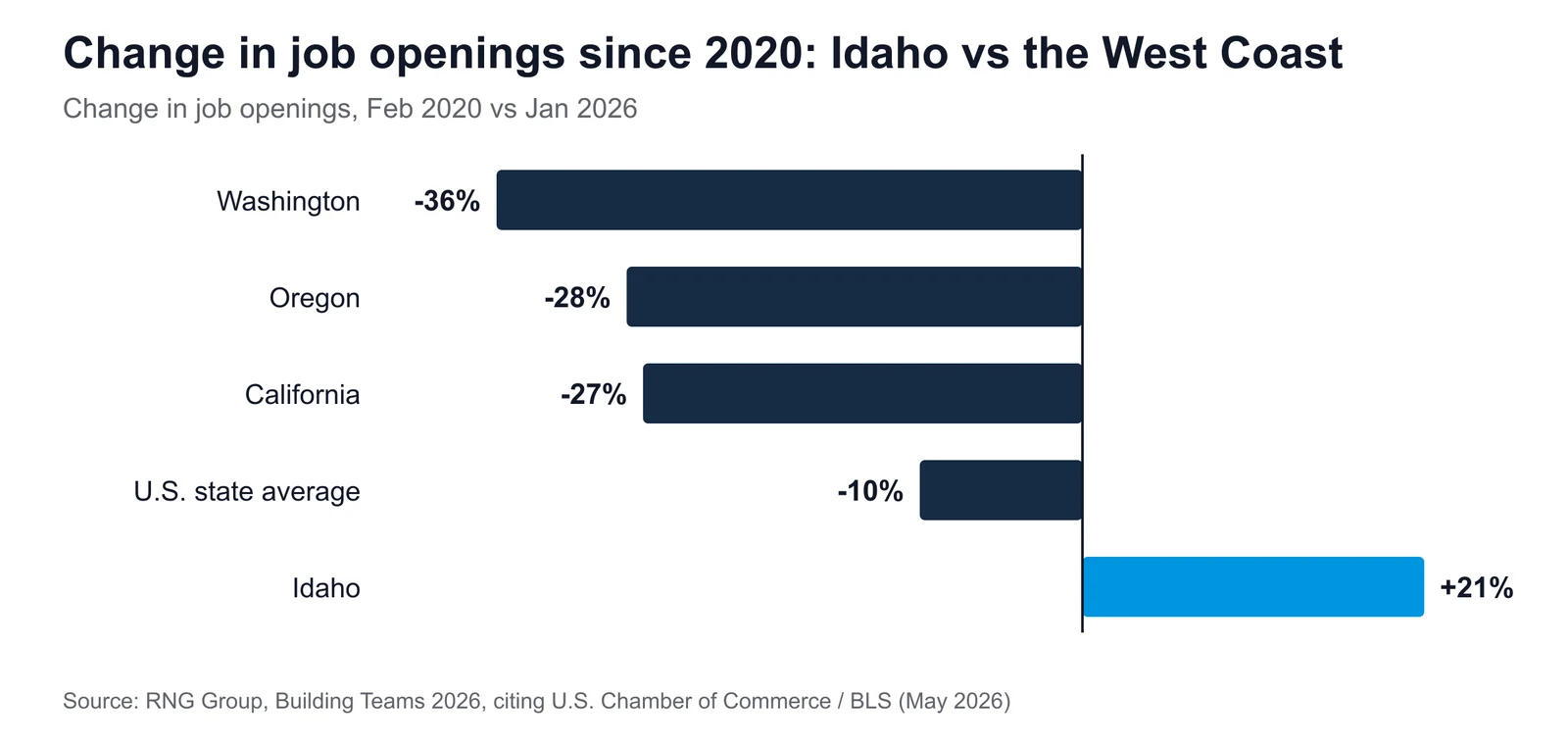
According to RNG’s 2026 hiring report, citing U.S. Chamber of Commerce and Bureau of Labor Statistics data, job openings have fallen 36% in Washington, 28% in Oregon and 27% in California since 2020.
Across the country, state job openings are down an average of 10%. Idaho went the other way, up 21%, the highest of any state.
Those West Coast engineers, GTM leaders and operators are open to relocating in a way they weren’t three years ago. And plenty already have.
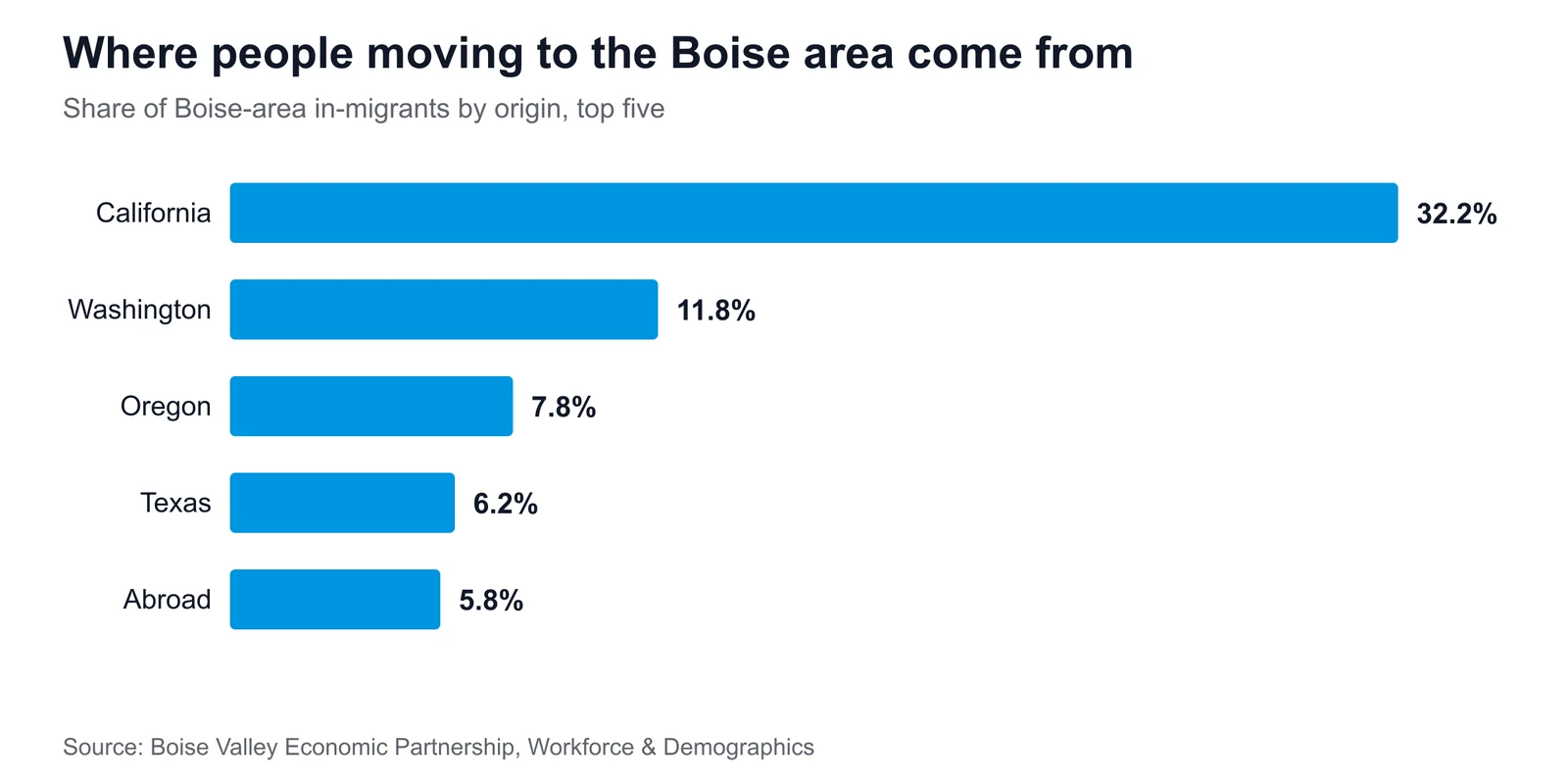
The Boise Valley Economic Partnership reports that 32.2% of people moving to the Boise area come from California, 11.8% from Washington and 7.8% from Oregon. That’s more than half of all in-migrants from three states where tech hiring shrank.
The regional labor force now stands at 457,514 (2025).
Boise tech talent isn’t only imported.
U.S. Census Bureau data (ACS 2020-2024) shows professional and technical services employ 10.0% of Boise’s working residents, about 12,960 people.
Demand isn’t slowing either. The Bureau of Labor Statistics projects software developer, QA analyst and tester jobs will grow 10% from 2025 to 2035, with about 106,100 openings a year.
One caution from the report: this window may not last. The companies that win relocating engineers are the ones already set up to move.
What it costs to hire software engineers and IT talent
Published salary data runs low for this market. Here’s how RNG’s 2026 market rates compare with published data.
| Role | Published data | RNG market rate 2026 |
|---|---|---|
| Software engineer (mid, 3-6 yrs) | $100k-$130k | $100k-$150k |
| Software engineer (senior) | $130k-$165k | $130k-$220k |
| Product manager (senior/lead) | $110k-$160k | $115k-$250k |
| Sales engineer | $100k-$130k | $100k-$180k |
Two things stand out. First, the AI premium is real.
Senior engineers fluent in AI tooling and modern development practices command the top of the range, and the gap between a strong generalist and an AI-enabled engineer is widening.
Second, mid-level roles have softened slightly as West Coast talent came onto the market. That’s a small negotiating window for patient companies, and the report is clear you shouldn’t count on it lasting.
For national context, the BLS median pay for software developers, QA analysts and testers was $134,040 in May 2025. For the full role-by-role tables, download RNG’s 2026 hiring report.
How to hire IT talent faster: the process that works
Great engineers don’t sit on the market. This is the technical recruiting process we run with clients, and it works whether you’re hiring developers for a startup or a cloud team for companies of all sizes.
- Write a short outcome scorecard before sourcing. Three to five outcomes and the competencies behind them. For a platform role, that might be safe infrastructure as code and an incident-free rollout. Share it with every interviewer.
- Capture the on-call and interface realities. Security wants control evidence, finance wants cost tags, product wants faster environments. Say so up front and candidates self-select.
- Use short, real work samples, not trivia tests. A cloud engineer outlines how to add a service to an existing landing zone. A service desk lead rewrites a common fix article. Keep it brief.
- Run structured interviews with clear lanes. One interviewer covers troubleshooting, one automation, one how they talk to non-technical users. Rubrics make feedback comparable and decisions faster.
- Tie references to outcomes. Did recovery time improve after they joined? Did repeat tickets drop? Ask for specifics.
- Decide fast. Protect one interview window a week, collect notes the same day, and make the offer when you find the person.
Speed is where most tech recruiting falls apart. See our guide to reducing time to hire and why candidate experience decides who says yes.
Slow loops and lowball offers both make our list of the most expensive hiring mistakes.

IT and tech roles we recruit for
As software engineer recruiters and IT recruiting specialists in the Treasure Valley, we’ve learned that each role needs its own search. We focus on recruiting information technology professionals from mid-level to leadership, including:
- Software engineers: mid-level, senior and lead
- Cloud and infrastructure: platform, DevOps and systems engineers
- Cybersecurity and network: security analysts, identity specialists, network engineers
- Service desk leadership, data engineering and product management
- Engineering leadership: managers, directors and heads of engineering
Our technology recruiters run each segment as its own search. Service desk hires need patience and clear writing; platform engineers need safe automation and calm operations; security hires need to show how they design controls that support delivery rather than block it.
For CTO and VP searches you want technical executive recruiters and a process closer to what an executive recruiting firm runs, because executive recruiting is its own discipline; see our page on CTO and VP Engineering searches. For engineering disciplines beyond software, see how we handle engineering hires, and for the roles nobody can seem to fill, our take on hard-to-fill roles in Idaho.
Proof it works: we made 8 hires for Treasure Valley SaaS company Engage Technologies, including a senior Azure application architect and a UI/UX designer. “RNG was able to connect us to the talent we would have otherwise not found,” said David Buckley, their CTO.
It’s all part of our technology recruiting work, alongside the other industries we recruit for.
How much do IT recruiters cost, and are they worth it?
Most information technology recruiting firms and technical recruiting companies charge the employer, and so do we.
Employers pay. Candidates never do.
RNG’s fee is a percentage of the hire’s first-year salary or a flat fee, depending on the search.
Whether that’s worth it depends on what a miss costs you.
RNG’s 2026 report cites the U.S. Department of Labor estimate that a bad hire can cost up to 30% of first-year earnings.
On a $150,000 engineer (the top of RNG’s mid-level range), that’s $45,000. The math: $150,000 x 30% = $45,000, before you count the months the seat sat empty.
Plug your own numbers into our cost per hire calculator and compare. If you’re weighing a recruiting partner for the first time, here’s how to work with a recruiter.
FAQ
What is the role of an IT recruiter?
An IT recruiter finds, screens and delivers technical candidates who can do the work. Then they run the process through to an accepted offer.
How much does it cost to use an IT recruiter?
The employer pays. At RNG it’s a percentage of first-year salary or a flat fee, and it’s always free for candidates.
Do you place contract IT staff?
No. RNG places full-time, direct-hire roles only, so we don’t cover contract or project staffing needs.
How long does it take to hire a software engineer in Boise?
It depends on the level and how quickly you decide. Our guide to reducing time to hire covers where the weeks go.
Can you recruit engineers from outside Idaho?
Yes. Many strong candidates are relocating from California, Washington and Oregon, which together account for more than half of Boise-area in-migrants (BVEP).
I’m a job seeker in tech. Can you help?
Yes, and it’s free. If you’re trying to find a job in tech, browse Boise jobs for current job opportunities.
Talk to IT recruiters who know Boise
We’ve been Boise recruiters since 2015, and you’ll deal with expert information technology recruiters who know this market, not a call center. Run your numbers through the cost per hire calculator, then book a discovery call and tell us about the role.
Filed under: Recruiting