
Candidate Experience: Why It Decides Who You Hire


The candidate experience shapes who says yes to you. When your process is unclear, slow, or impersonal, good people walk away, not because the role wasn’t right, but because the process sent a message.
That message reaches the candidates you most want to hire. Here’s what candidate experience is, where most employers lose people, and the fastest ways to improve it.
What is candidate experience?
Candidate experience is the sum of every interaction a job seeker has with your company during the recruitment process. It starts the moment someone finds your job listing or lands on your career site, and it runs through the application, the interview, the offer, and even how you communicate with people you don’t move forward.
It is the first impression that becomes the first chapter of the employee experience. A candidate journey map, which traces each stage from finding the listing to the offer or rejection, shows you what that looks like from the other side of the table.
Every touchpoint communicates something. The components of the candidate experience are unglamorous: the job description, the application process, the interviews, the offer, the follow-through.
How long your application takes, how quickly you respond, how your interview is structured, how you close out the process for candidates who don’t get the role: every one of those candidate interactions tells a person what it’s like to work for you. A strong candidate experience doesn’t require a large HR department or expensive software.
It requires consistency, clarity, and respect for people’s time. Those three things attract serious, qualified candidates and keep them engaged at every stage of the hiring process.
Where do employers lose good candidates?
Most recruiting processes have predictable drop-off points where candidates disengage. Knowing them is the first step to fixing them.
- A long, friction-heavy application process. Anything over 20 minutes filters for desperation, not talent. Qualified candidates with options rarely complete a lengthy form for a role they’re not yet sure about. Make it easy for candidates to start the conversation.
- Radio silence after applying. If a candidate submits an application and hears nothing for two weeks, they assume disorganization or disinterest. Top candidates won’t wait around to find out which one it is. For someone mid job search, silence reads as a no, and candidate engagement rarely recovers from it.
- No clear timeline. A longer process is fine when candidates know what to expect. Uncertainty forces people to make decisions about competing offers without the information they need. Set candidate expectations early and update them when things change.
- A disorganized interview process. An interviewer who hasn’t read the resume, asks repeated questions, or doesn’t know the salary range sends a clear signal about how the company runs internally.
- Slow decisions. When you take more than a week after a final interview to extend a job offer, candidates accept other offers. The ones who wait indefinitely are often the ones with no better options on the table.
- No closure for declined candidates. In a market like Boise, word travels. People applying for jobs share their experiences, and a poor candidate experience follows you into the next search. How you treat people who don’t get the role shapes your employer brand for years.
| Drop-off point | What candidates read into it | The fix |
|---|---|---|
| Application takes over 20 minutes | My time isn’t valued | Resume plus two or three targeted questions |
| Silence after applying | Nobody’s home | Acknowledgment within 24 hours |
| No timeline | They’re winging it | A next step and a date, each time |
| Unprepared interviewers | This is how the whole company runs | Brief everyone before the interview |
| Offer takes over a week | I’m the backup choice | A decision deadline you keep |
| No closure after a no | They don’t respect people | A brief, personal follow-up |
How can you improve candidate experience quickly?
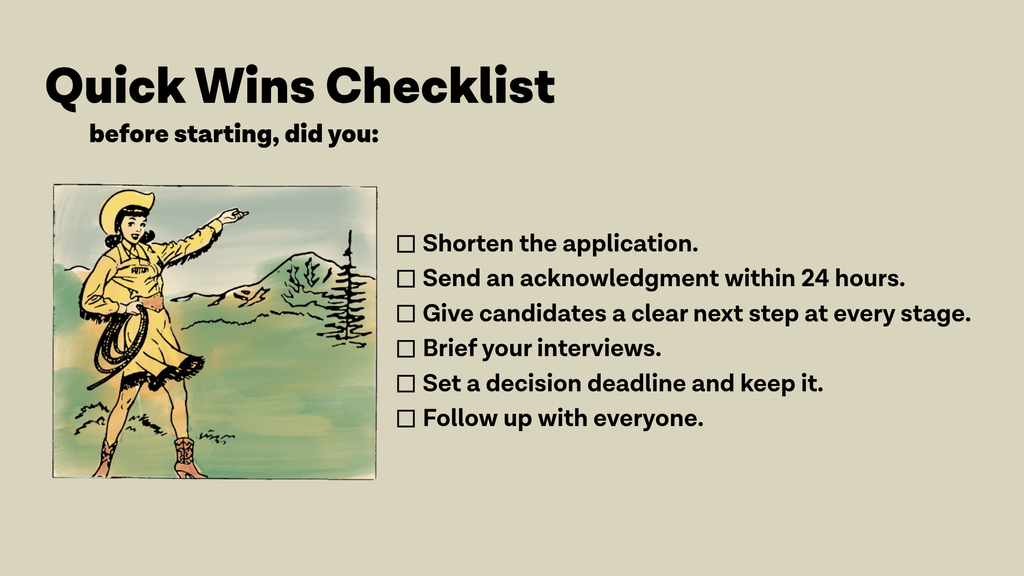
You don’t need to redesign your approach to recruitment and hiring from scratch to see real results. Most candidate experience best practices boil down to three things: communicate, be prepared, decide quickly.
Candidates don’t want a seamless, AI-scored talent acquisition journey; they want to know what’s happening. A better candidate experience usually means doing less, not more, and most of these changes take under a week to put in place.
Simplify your application process. A resume and two or three targeted questions is enough for a first round.
Gather the rest in conversation, not in a form.
Send an acknowledgment within 24 hours. A simple automated reply confirming receipt and outlining next steps eliminates uncertainty at no cost.
Set it up once and let it run.
Automation should end there, though. From the first real conversation on, a personalized candidate experience beats any drip sequence.
Give candidates a clear next step at every stage. End each interview by telling people what comes next and when to expect it.
If timelines shift, communicate the delay before the candidate has to ask.
Consistent communication is the whole game.
Brief your interviewers. Everyone in the room, from the recruiter to the hiring manager, should have read the resume, know the role, and understand what they’re evaluating.
The best recruiting teams treat this like a project kickoff, not a formality.
Consistency across interviewers signals a well-run operation.
Set a decision deadline and keep it. Treat your promised timeline like a commitment.
If you told a candidate you’d have an answer by Thursday, make Thursday the deadline.
Follow up with everyone. Yes, even the candidates you’re not moving forward.
A brief, respectful message makes it a positive experience for all candidates, protects your reputation, and keeps the door open for future applications.
Ghosting candidates after the interview costs more than the two minutes the email takes.

Together, these create a candidate experience that feels like real people run it. Because they do.
Delays in communication are often symptoms of a slow overall process. For a breakdown of the specific bottlenecks that extend timelines, see our guide on how to reduce time to hire.
Why is candidate experience important?
Candidate experience is important because it decides whether the people you most want to hire say yes. In CareerPlug’s 2025 job seeker survey, 66 percent of candidates said a positive experience influenced their decision to accept an offer (CareerPlug, 2025).
The reverse holds too. Poor experiences, such as a lack of communication or unclear job expectations, led 26 percent of job seekers to decline offers in 2024 (CareerPlug, 2025).
Candidate experience matters for quality of hire, too.
The best candidates have choices.
In a competitive job market, top talent is in multiple processes at once, and they evaluate your company as carefully as you evaluate them. They decide based on their experience of your process, not the value proposition on your careers page.

When your process is organized, communicative, and respectful, it signals that your company culture runs the same way. That attracts the right candidates, the people who value those qualities and are most likely to thrive with you, and the same qualities attract and retain them once they’re employees.
The interview carries the most weight: negative interactions during interviews caused 36 percent of candidates to decline offers (CareerPlug, 2025).
A well-run interview also creates conditions where candidates can perform their best. A person who is anxious, confused, or waiting too long for a response isn’t showing you what they can do.
A well-run process gives candidates enough clarity to show you who they are.
Quality of hire improves when you stop losing people at the drop-off points described above. Every candidate who walks away from a broken process could have been a strong hire.
Improving the experience keeps qualified candidates in your talent pool long enough to make the offer. That’s what makes candidate experience important: it’s not a soft metric, it’s a practical business outcome.
A positive candidate experience compounds, too: people who enjoyed your process share their experience with others, and your employer brand starts doing some of the work for you.
The experience doesn’t end when someone signs, either. A smooth onboarding process carries the same signal into a new hire’s first weeks.
Here’s how to prevent drop-offs between offer and onboarding.
For a wider look at building a healthy hiring process from the ground up, read our pillar guide: How to Hire Employees in Boise.
Frequently asked questions
What is the biggest mistake employers make with candidate experience?
Silence. Candidates can handle a wait, but failing to communicate about timelines, delays or decisions is the fastest way to lose their trust and interest.
Does candidate experience affect whether someone will accept a job offer?
Yes, and the interview is where it shows most: negative interactions during interviews caused 36 percent of candidates to decline offers (CareerPlug, 2025). The decision to accept a job is a judgment about the whole company, and your process is the main evidence a candidate has.
How do you measure candidate experience?
Measuring candidate experience starts with offer acceptance rates, application conversion rate, and candidate satisfaction ratings or a net promoter score from a short candidate experience survey. Two or three questions after each stage gather feedback that’s more honest than any dashboard, especially from the people you didn’t hire.
How can you improve the candidate experience without a dedicated HR team?
You don’t need a candidate experience specialist: a clear job description that attracts talent, a prompt acknowledgment, a prepared interviewer and a timely decision are enough to stand out from most employers. Good hiring is mostly manners at scale.
Where should you start?
You don’t need an exceptional candidate experience by some consultant’s framework. A great candidate experience is mostly showing up prepared, telling the truth, and answering on time.
If you want a second set of eyes on where your process leaks people, start with the scorecard below.
Filed under: Recruiting · Recruiting Process