
How to Work With a Recruiter (and What We Do)


What does a recruiter do? A recruiter finds, screens and delivers people for a role you need filled, and most of that work happens before you ever see a resume.
The employer pays the fee. The candidate never does.
This guide is for the hiring manager or founder deciding whether to bring a recruiter in, and how to get the most out of working with a recruiter once you do. At RNG Group we place full-time, direct-hire roles only, so that’s the lens.
One thing first: you don’t need to be hiring a C-suite executive, or be a big company, to work with a recruiter. A single, important seat is reason enough.
What does a recruiter do?
The U.S. Bureau of Labor Statistics describes recruitment specialists as people who “find, screen, and interview applicants for job openings.” That’s the baseline.
An agency recruiter works that same recruitment process, plus the parts nobody sees.
Here’s the work behind a placement, in order:
- Intake with the hiring manager. What the person will own, what success looks like at 90 days, and the real pay range, not the one in an old job description.
- Mapping the market. Who does this job well locally, who’s paying what, and where the top talent sits.
- Sourcing. Approaching people who aren’t applying anywhere. The best potential candidate for an open position is usually busy doing a good job somewhere else.
- Screening for skill and fit. Conversations, not keyword scans, so only qualified candidates reach you.
- Coordinating interviews. Calendars, prep and feedback on both sides.
- Keeping candidates warm. Good people have options, and silence loses them.
- Managing the offer through to the start date. Pay, timing, counteroffers and resignation.
What you see is the shortlist and a handful of interviews. What you pay for is steps 1 through 6.
Here’s how that plays out (an illustration, not a specific client). Say a growing company asks for a controller to clean up month-end close, and the intake shows the real problem is a team that needs leading.
That changes the search. Instead of screening for software skills, the recruiter looks for people who’ve built a finance team before, approaches a few who aren’t looking, and the hiring manager meets only the strongest two.
We grow our network mainly through relationships: referrals, networking events and word of mouth.
Our goal isn’t to have the biggest network. It’s to have the right connections.
Types of recruiters: in-house, agency, staffing and executive search
“Recruiter” covers a few different jobs. Here’s how the different types of recruiters compare.
| Type of recruiter | Works for | Typical roles | How they’re paid | Use when |
|---|---|---|---|---|
| In-house (corporate) recruiter | One employer | Any role at that company | Salary from the employer | You hire steadily and have the team for it |
| Agency recruiter (RNG: direct-hire agency) | Many client employers | Permanent, full-time roles | Employer pays a fee when a hire is made | The role is hard to fill or the right people aren’t applying |
| Staffing agency | Many client employers | Temporary or contract staff | Employer pays for hours worked | You need short-term cover |
| Executive search | The hiring company, usually on retainer | Senior leaders and C-suite | Employer pays, often part up front | The hire is senior, confidential or high-stakes |
In-house recruiters (also called corporate recruiters or internal recruiters) work for one employer, usually inside human resources or talent acquisition. Agency recruiters work for many clients and are paid by the employer when a hire is made.
Staffing agencies mostly place temporary or contract staff. That’s the real answer to the staffing agency vs recruiter question: one fills gaps for a while, the other fills seats for good.
Executive search is a deeper, usually retained process for senior leaders; see our executive search page for how that runs.
Where RNG sits: we’re a recruitment agency that places full-time, direct-hire roles only, from entry level to C-suite. We recruit in sales, marketing, finance, accounting, HR, IT and operations.
What we don’t do: temp work, temp-to-hire, contract placements or RPO. If you want the detail on the model, read our guide to direct-hire placement.
Weighing whether to hire an in-house or outside recruiter? We covered that too.
What does a recruiter cost?
Employers pay recruiter fees; candidates never do. Agency fees are usually a placement fee based on the hire’s first-year salary.
RNG charges a percentage of first-year salary or a flat fee, depending on the search.
Now the other side of the ledger. SHRM benchmarking put the average cost per hire at nearly $4,700 in 2022, and that’s just to fill the seat.
Getting it wrong costs more.
RNG’s 2026 hiring report cites the U.S. Department of Labor estimate that a bad hire can cost up to 30% of first-year earnings.
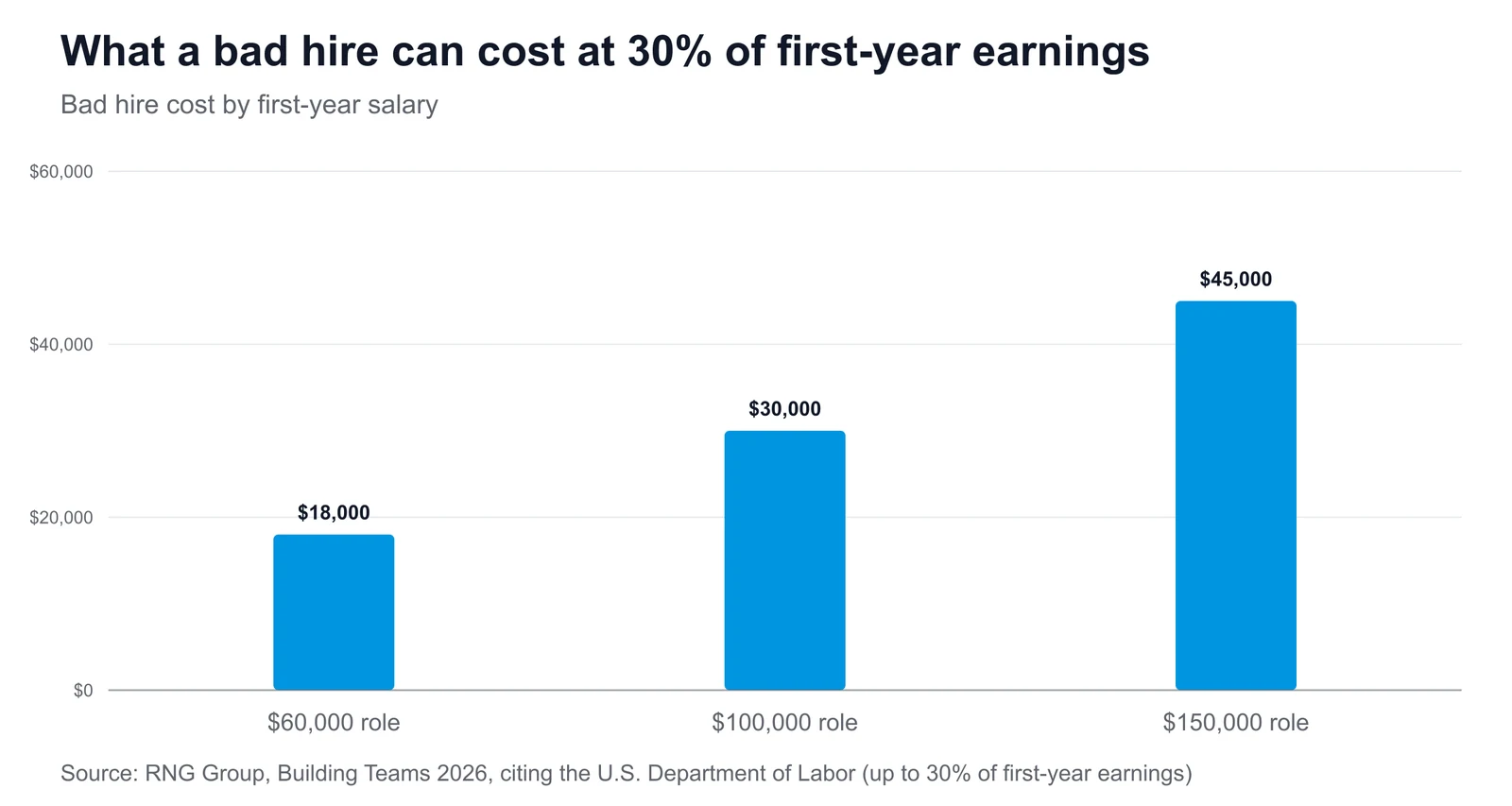
That’s $18,000 on a $60,000 role and $30,000 on a $100,000 role, per the report. At the same 30%, a $150,000 hire comes to $45,000. Read more on the true cost of a bad hire, or run your own numbers through our cost per hire calculator.
When is a recruiter worth it?
You probably have a hiring need a recruiter can solve if the role has sat open for weeks, or the people you want are employed and happy, so a job post won’t reach them.
The same goes if you need to fill positions across several functions at once in a tight job market, the hire is senior or confidential, or nobody on your team has time to run a proper hiring process.
RNG’s report calls this “going it alone too long.” Founders’ own networks fill the first few seats, but they rarely have the reach or the time to source across several functions while also running the business.
It’s also worth reaching out when a role needs people who are not applying. That’s where a recruiter earns the fee.
And when isn’t it worth it?
If a role draws a deep pool of active applicants and your HR team has capacity, you may not need us. We’d rather tell you that than take the search.
If you’re comparing firms, here’s our guide to choosing an agency in Idaho. Skipping the prep is one of the most expensive hiring mistakes we see, whoever runs the search.
How to work with a recruiter and get better hires
The best recruiters work closely with hiring managers and shape the search around your specific needs. The searches that go well have a few things in common, and most of them are on your side of the table.
- Share the real context. Why the seat is open, what went wrong last time, and what the job is like on a bad day.
- Agree the process up front. Interview stages, who’s involved and the timeline.
- Give the real compensation range. A lowball offer tells a candidate how you operate.
- Give feedback within a day or two. Good people don’t wait around.
- Keep the interview panel small and aligned. Four people asking the same question wastes everyone’s time.
- Treat your recruiter as a partner. A good one will push back, and you want that.
This lines up with the framework in RNG’s report: define the role before you post, know your market, and build a process that respects everyone’s time. Strong candidates are evaluating you as much as you’re evaluating them, so candidate experience and company culture show up in every step.
Want the detail? Here’s our recruiting process, and our guide to reducing time to hire.

Working with RNG as a candidate
If you’re a job seeker who landed here, welcome.
RNG is free for candidates, always. Recruiters get paid by the employer when a hire is made, never by you.
We help people find careers, not gigs. That means we get to know your career goals, look over your resume and online presence, and only put you forward for roles where you’ll fit.
We’ll prep you for interviews, help with the offer conversation and stay in touch through the move. If you’re changing industries or relocating, we know the people, the area and the companies.
Early-career people are welcome too. We place a candidate at every level, from new graduates to C-level executives.
Browse Boise jobs or get in touch. There’s more in our recruiting FAQs.
FAQ
What does a recruiter do for employers?
A recruiter finds, screens and delivers vetted candidates, runs the process and manages the offer. The hiring manager only meets people worth meeting.
Do recruiters get paid if you get hired?
Yes, and the employer pays. Candidates never pay RNG.
What is the difference between a staffing agency and a recruiter?
Staffing agencies mostly fill temporary or contract roles. A direct-hire recruiter fills permanent roles on your payroll.
Is a recruiter worth it for just one hire?
Often, yes. If the role is hard to fill, senior, or costing you money while it sits open, one hire is plenty.
How long does it take a recruiter to fill a role?
It depends on the role and how fast you give feedback. Our guide to reducing time to hire shows where the time goes.
Talk to a recruiter who’ll tell you straight
We’re Boise recruiters who’ve spent 10+ years and 300+ placements (per our 2026 report) learning what makes a search work. Not sure you’re ready?
Take the Hiring Health Scorecard, then book a discovery call.
Filed under: Job Search · Recruiting · Recruiting Process