
The 6 Most Expensive Hiring Mistakes (and How to Avoid Them)


Hiring the wrong person hurts more than your pride.
A single hire that doesn’t work out can cost up to 30 percent of that person’s first-year earnings, according to the U.S. Department of Labor figure cited in RNG Group’s 2026 hiring report.
At manager level it gets worse. The same report estimates 3 to 5 times annual salary once you count lost productivity, team disruption and the time it takes to backfill.
$18,000 on a $60,000 role. $30,000 on a $100,000 role.
RNG Group 2026 report, citing the U.S. Department of Labor
We won’t redo the math here. The true cost of a bad hire breaks it down line by line.
After 10+ years and 300+ placements (per our 2026 hiring and compensation report), we keep seeing the same common hiring mistakes employers make.
They’re rarely about bad intentions and almost always about moving fast without a clear hiring process.
Here are the six most costly hiring habits we see in growing Boise and Idaho companies, with the fix for each. These are the common hiring mistakes to avoid if you want your next hire to stick.
1. Posting the job before you’re ready
The most expensive mistake hiring managers make is treating the job post as the starting point. It isn’t.
A job post is the output of a clear internal conversation, not the starting point.
Before anyone writes a job description, the hiring manager and everyone with a say should ask the right questions and define the role together:
- What this person will own, day to day
- What success looks like at 90 days, and at a year
- Who thrives at your current stage and culture, not just on paper
- What you’re really willing to pay
What it costs: Skip it and you interview the wrong candidates, make offers that don’t land, or hire someone because the candidate’s resume checks every box, even though they don’t fit the role.
A classic: a founder budgets $60,000 to $70,000 for an office manager when the business needs a strategic operator. That person costs $90,000 to $115,000 or more, per our 2026 report.
The fix: Slow down for 48 hours before you post. Agree on scope, range, who owns the hiring process and how fast decisions get made, so your new hire walks into the job you advertised.
It takes a few hours and saves weeks. For the rest of the process, see how to hire employees in Boise.

2. Benchmarking pay off outdated data
Companies lose great candidates because the first offer shows they haven’t done their homework. It’s a common mistake: you can’t hire the best people with last year’s numbers.
To a candidate, a lowball offer isn’t just a number. It’s information about how you operate.
What it costs: An offer under the candidate’s target salary risks a flat no, and it can feel disrespectful even when nobody meant it that way.
Compensation benchmarking off salary surveys is risky. Most use months-old data averaged across broad regions.
Our 2026 report found published pay for business development and account executive roles is often understated by 30 to 50 percent. If you’re hiring in sales, assume the market is higher than anything you’ve Googled.
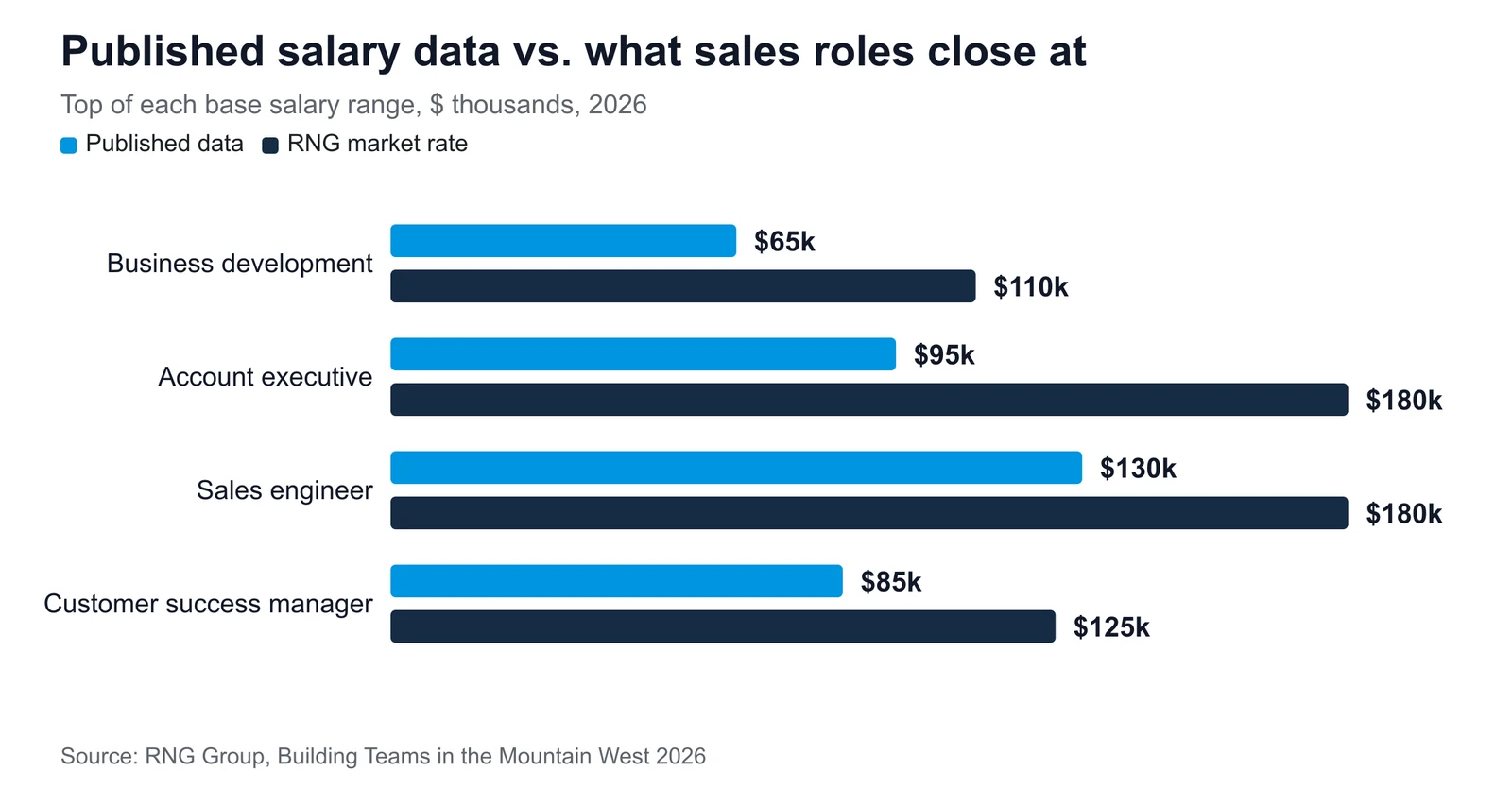
The fix: Use current market data, talk to people actively placing the role, and build enough flexibility into your range to move for the right person.
Then raise compensation early, because it saves everyone months.
In the first conversation, try: “Here’s our budget range. Does that line up with what you’re looking for?”
3. Confusing speed with urgency
When you’re growing, every open seat feels like it’s on fire, and you feel pressured to fill it yesterday.
But urgency without process produces the wrong hire, and the wrong hire at the wrong stage can set a company back months.
What it costs: The pitfall on the other side is just as real. Moving too slowly, or leaving a stack of resumes in the queue for weeks, sends qualified candidates to faster employers.
Those are missed opportunities that rarely come back.
Job seekers who feel ignored remember it. The best candidates are evaluating you as much as you’re evaluating them, and a slow, disorganized interview process sends the wrong signal.
Every stage is part of the hiring process they judge you on, so candidate experience matters long before the offer.
The fix: Decide what to prioritize first, then move fast through a defined process. An efficient hiring process isn’t a rushed one: set clear interview stages up front, share them with candidates, and hold your hiring teams to the timeline.
Check in weekly with anyone you’re serious about, even if the update is “still deciding, you’ll hear from us Friday.”
No time to screen applications this week? Say so and set a date.
Give feedback at each stage, and make the hiring decision quickly once you find the right person.
Top talent doesn’t stay available long, so here’s how to reduce time to hire without missing out on great people.
4. Hiring for today, not for where you’re going
Growing companies often hire for whatever’s burning right now instead of hiring for scale. The catch: the person who can manage chaos at 10 employees isn’t always the person who can build and lead a team at 50.
What it costs: You outgrow the new employee, they outgrow the job, or both, and you pay for turnover you could have seen coming. The right employee at 10 people can be a mismatch at 50.
Once people are in the seat, here’s how to reduce employee turnover.
The fix: You don’t need to over-hire for a future that isn’t guaranteed. Be honest about where the role is heading and look for someone who can grow into it.
Or call it a bridge hire, out loud, and plan the onboarding and the next hire around that.
There’s no wrong answer, as long as your hiring choices are honest and you judge the right people against the right things. That’s how long-term success gets built.
5. Underestimating culture fit (and over-weighting the checklist)
At 5, 10 or 15 people, every hire changes your company culture and team dynamics. A technically strong candidate who doesn’t share your values or work style has an outsized impact on a small team, far more than they would at a 200-person company.
The flip side: the perfect candidate on paper is rare. Every company runs its own tools, so demanding a 1:1 match on the job requirements shrinks your talent pool for no good reason.
That goes double for technical professionals, where no two tech stacks match.
What it costs: Hiring the wrong people for a small team hits team morale first, often before the work suffers. Pass on a fast learner because they’re missing one tool, and you lose a strong hire over a qualification you could have trained.
The fix: Weigh soft skills like communication, teamwork and adaptability as seriously as the technical checklist. Look at the gap between someone’s skills and experience and what the job needs, and how fast they learn.
Just don’t let “culture fit” become code for “people like us.” Unconscious bias creeps in fastest when fit is left vague.
Brush up your team’s interviewing skills, then evaluate candidates with behavioral interview questions about how they work:
- “Tell me about a time priorities changed halfway through a project. What did you do?”
- “How do you like to get feedback, and how do you give it?”
- “What kind of environment brings out your best work, and what drains it?”
Ask everyone the same questions so your selection process stays fair, and score answers against what your team needs, not gut feeling.
A reference check that asks how someone handled change beats one that only confirms dates.

6. Going it alone too long
Most growing companies start by hiring people through their own networks. That works until it doesn’t.
Personal connections rarely have the reach, the process or the time to fill positions across several functions while you’re also running a business.
What it costs: Roles sit open and your leaders become part-time hiring teams.
Waiting too long is a big mistake once several roles are open. At that point you need a talent acquisition plan, not a string of emergencies.
The fix: Bring in a recruiting partner before the pressure to fill a position takes over.
That’s not failure. It’s a strategic decision to protect the resource your business success depends on most: time.
This is where we come in as Boise recruiters. RNG Group handles full-time, direct-hire recruitment only, and our fee is either a percentage of first-year salary or a flat fee.
Weighing it up? Start with how to work with a recruiter, or read our notes on small business hiring in Boise if you’re a smaller team.
Hiring mistakes to avoid: a quick checklist
The short version of what to avoid when hiring, one line each:
| Mistake | The fix |
|---|---|
| 1. Posting before you’re ready | Answer the four questions, then wait 48 hours before the job goes live. |
| 2. Benchmarking pay off old data | Use current market data and raise compensation in the first conversation. |
| 3. Confusing speed with urgency | Set interview stages and timelines, check in weekly, decide fast. |
| 4. Hiring only for today | Be honest about where the role is heading, or call it a bridge hire. |
| 5. Over-weighting the checklist | Ask every candidate the same work-style questions, and check references. |
| 6. Going it alone too long | Bring in outside help when your network runs dry or several roles open at once. |
Want to see where your process is leaking? Take our free Hiring Health Scorecard to find which hiring practices need work first.
It’s the quickest way to avoid common hiring mistakes and hire with confidence.
Rather talk it through? Book a discovery call with our team.
FAQ
What is the #1 reason for bad hiring?
In our experience, it’s moving fast without a defined role and process. That’s why the biggest hiring mistake we see is posting a job before you know what the person will own, what success looks like and how you’ll interview for it.
How much does a bad hire cost?
Up to 30 percent of first-year earnings, per the Department of Labor figure cited in our 2026 report, and 3 to 5 times salary at manager level. Our full cost breakdown covers the rest.
How do we hire faster without lowering quality?
Speed and quality of hire aren’t opposites. Hiring the right person faster starts with defining the role, then setting your interview stages and timelines, and deciding quickly once you find them.
When should we bring in a recruiter?
When your network runs dry, or when you’re filling several roles at once and hiring starts eating the time your leadership team needs for everything else.
Filed under: Direct-Hire Placement · Recruiting Process