
How to Reduce Time to Hire (Without Lowering the Bar)


Every day a role sits open, your team absorbs the gap. Work shifts, timelines slip, and the people you are counting on start to burn out.
Reducing time-to-hire isn’t about cutting corners. It is about running a sharper process so the right candidate walks through the door before you lose them to someone else.
If you are building the process from scratch, start with our guide on how to hire employees. Here is what good time to hire looks like, why most companies fall short of it, and effective ways to reduce time-to-hire while protecting the quality of hire.

What Is the Average Time to Hire?
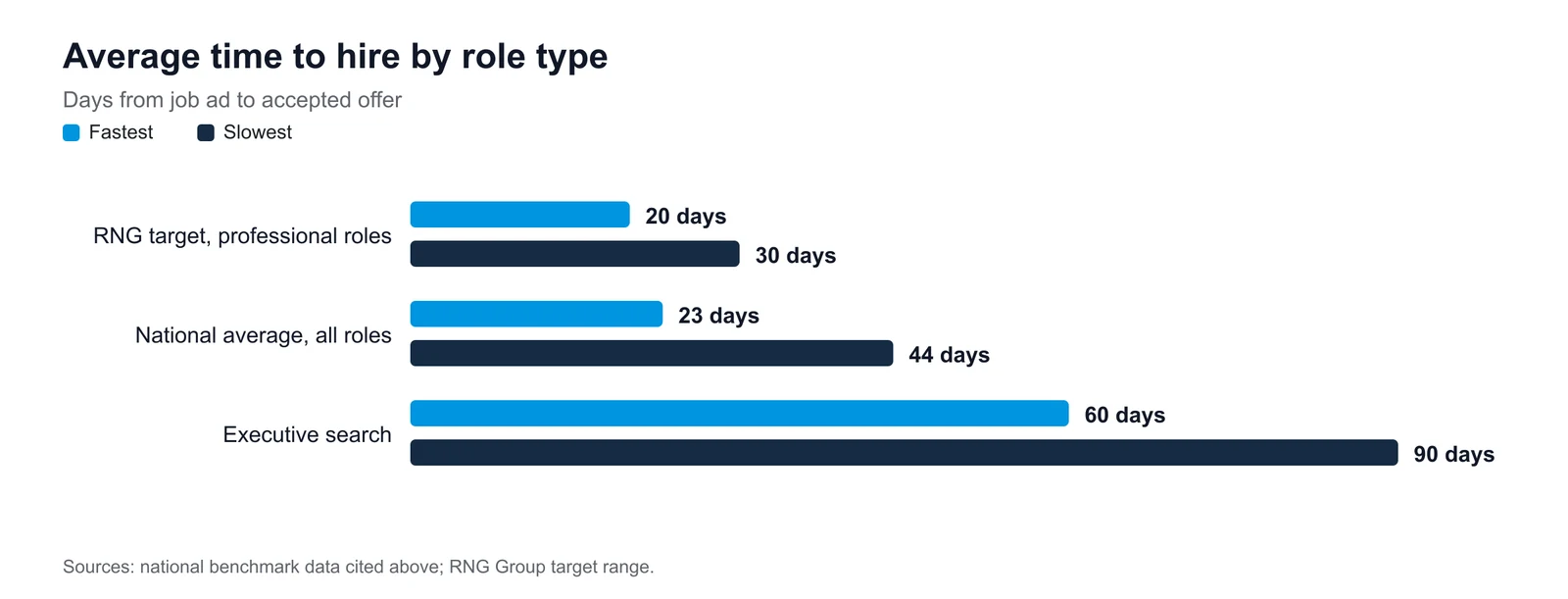
The national average time to hire sits between 23 and 44 days, depending on the industry and role level. Time to hire measures the days from job ad to accepted offer, and it is the metric most hiring teams watch first.
Measure time to hire from the day the role is approved, not the day the first resume lands, or you will flatter your own hiring cycle. In competitive hiring markets like tech and construction, that window shrinks because top talent has options and they move faster than your process does.
In executive search, a 60 to 90 day timeline is not unusual given the depth of evaluation required.
But here is what the benchmark does not tell you: average includes a lot of slow. Plenty of companies drag timelines out through avoidable delays and have normalized it as “just how hiring works.” It does not have to be.
A good target for most professional roles is 20 to 30 days from job posting to accepted offer. Roles with multiple rounds of interviews, assessments, or executive sign-off may run longer, and that is fine, as long as every day has a purpose.
5 Bottlenecks That Slow Hiring Down
If your hiring is dragging, it is rarely one big problem. It is usually a handful of small friction points stacking up.
1. A vague job description. When the role is not clearly defined before you post it, your job description attracts unqualified applicants and you spend weeks sorting through resumes that should never have come in. Clarity at the start reduces time spent at every stage that follows, and it reduces the time your team loses to the wrong shortlist.
2. No defined interview process. When there is no agreed-upon structure, interviews multiply. One manager adds a round.
Then a second. Suddenly a three-step process becomes six and candidates who were ready to commit have moved on.
3. Slow interview scheduling. Coordinating calendars across a hiring team is one of the most underestimated causes of a slower time to hire. Candidates left waiting three to five days between each step read it as a signal that you are not organized, or not that interested.
That is how you end up losing top candidates to competitors who simply answered faster. Silence is expensive: nothing will keep candidates engaged like knowing what happens next.
4. Approval bottlenecks. If a job offer requires three layers of sign-off before it goes out, and those people are not looped in early, you will lose your top candidate to a company that moved while you were waiting on a signature.
5. Reactive sourcing. Posting a job and waiting is a slow strategy. By the time the role opens, a strong talent pipeline should already exist.
When companies start sourcing from zero every time, time to hire suffers every time.
| Bottleneck | What it costs you | The fix |
|---|---|---|
| Vague job description | Unqualified candidates and weeks of resume sorting | Define the role with whoever owns it, before you post it |
| No defined interview structure | Rounds multiply and your best candidates move on | Agree the rounds, the owners, and what each one evaluates |
| Slow internal scheduling | Three to five dead days between every step | Batch it: offer two or three slots in one short window |
| Approval bottlenecks | Losing top talent while you wait on a signature | Brief every decision maker before the final stage |
| Reactive sourcing | Your clock starts at zero on every single role | Build a strong talent pipeline before the role opens |
How to Reduce Time to Hire Without Sacrificing Quality
Moving faster does not mean making hasty decisions. These hiring strategies to reduce hiring times remove the waste from your recruitment process so you can still make informed decisions, faster.
That is proactive talent acquisition, and it is how we find the unfindable talent.
- Define the role before you post it. Sit down with the hiring manager and nail down the must-haves, the nice-to-haves, and what a high-quality hire looks like at 90 days. That conversation takes an hour and saves weeks.
- Standardize your interview structure and let your ATS carry the admin. Decide how many rounds you need, who owns each one, and what each round is evaluating. A shared scorecard lets everyone screen candidates against the same bar, so scheduling is faster and feedback is cleaner.
- Batch your scheduling. Instead of filling one interview slot at a time, offer candidates two or three options across a short window. This one change can streamline the calendar and shave four to seven days off the time it takes to make a hire.
- Loop in decision makers early. The hiring manager, the final approver, and anyone touching the offer letter should be briefed before you reach the final stage. No one should see a finalist name for the first time on the day you are ready to extend an offer.
- Build a warm pipeline. The best time to recruit for a role is before it opens. Whether through LinkedIn, a recruiting partner, or your own network, having a shortlist of potential candidates ready means your time to hire starts ahead of zero.
- Work with a recruiter who sources proactively. At RNG, we do not wait for the job board to deliver results. We go and find the passive candidates who are already doing great work, often for someone else, and we start that conversation before the clock is running.
The Cost of a Slow Hire
Every day a seat is empty has a price tag, and an unstructured process can significantly increase time to fill across every open role. For a breakdown of what vacancy is costing your business in real dollars, see the real cost of hiring in Boise and use our Cost of Vacancy Calculator to run your own numbers.
FAQ
What is a good time to hire?
For most mid-level professional roles, 20 to 30 days from posting to offer accepted is a healthy benchmark. Executive roles and highly specialized positions often run longer, and that is expected. The goal is to eliminate the delays that add time without adding value.
What slows down hiring the most?
Unclear role definitions, unstructured screening, and slow internal scheduling are the top culprits. Most hiring delays are process problems, not candidate problems, and they are usually one of the costly hiring mistakes managers make without noticing. Fixing the hiring process is almost always cheaper than widening the applicant pool.
Can I hire faster without reducing quality?
Yes. Speed and quality are not opposites. A structured, well-prepared hiring process moves faster than a disorganized one because every step has a clear purpose, so your hiring decisions rest on better information, not less. Eliminating the unnecessary steps is what accelerates things, not rushing the ones that matter.
When should I use a recruiter to speed up hiring?
If a role has been open for more than 30 days, if you are struggling to find qualified candidates through job boards, or if the role is specialized or senior level, a recruiter can significantly compress your timeline. We maintain an active network so the sourcing phase, often the longest, starts from a much shorter runway.
How does time to hire affect my team?
Every day a role is open, the work still gets done, just by people who are already carrying a full load. Extended vacancies drive burnout, lower morale, and in some cases drive turnover. Faster hires protect the team you already have.
How do I reduce time to hire without compromising quality?
Cut the waiting, not the vetting. The steps that protect quality are the ones where you spend time vetting a strong candidate: structured interviews, real reference checks, a clear scorecard. The steps that cost you days are scheduling gaps, approval queues, and rounds nobody planned. Reduce time-to-hire without sacrificing candidate quality by attacking the second list and leaving the first alone. That is how you move faster without compromising the quality of the hire.
Does candidate experience affect hiring speed?
More than most hiring teams expect. A slow, silent process tells your best candidates exactly what working with you is like, and it dents your employer brand long after the seat is filled. Answering quickly is a signal about your company culture, and it wins you the people who had other options. Efficient hiring also protects the workload of the team covering the gap, which is the cost nobody puts on a spreadsheet.
Ready to see how your hiring process stacks up?
Take the Hiring Health Scorecard and learn how to reduce time to hire without losing the people you most want to keep. It gives you a clear picture of where your process is working and where it is costing you time, money, and good people.
Filed under: Direct-Hire Placement · Recruiting Process