
Cost per hire in Boise: what it costs to hire an employee in 2026


SHRM’s 2025 benchmarking report puts the average cost per hire at $5,475 for nonexecutive roles and $35,879 for executive roles. Boise pays below the US average, but Ada County wages rose 7.9 percent in a year against 3.9 percent nationally, so the cost of hiring here is climbing fast (BLS, 2026).
Hiring someone in Boise costs more than their salary, and most business owners find that out the hard way. These hiring costs, from recruitment advertising and screening to training, lost productivity and employer taxes, all land on top of the pay you agreed.
This guide gives you the national industry benchmark, the Boise wages behind it, the Idaho tax figures, and a straight answer on recruiter versus doing it yourself. It is the pillar for our cost-per-hire series, so the formula and the bad-hire math each get a short capsule here and a full article of their own.
What is cost per hire?
Cost-per-hire is the total cost a company spends to fill one open position: internal and external recruiting costs added together, then divided by the number of hires. The Society for Human Resource Management (SHRM) and the American National Standards Institute (ANSI) standardized the cost per hire definition, and it is usually shortened to CPH.
It is not the salary. It covers the full cost of recruiting from the moment you decide you need someone to the day that person accepts, and it is one of the few HR metrics that tells you whether your hiring process is efficient.
When business owners tally what they spend on recruitment, they think about the obvious line items: a job board posting, maybe a background check. What they miss is the internal cost of every hour their team spends sourcing, screening and interviewing, which in our searches is the line item nobody has costed.
How do you calculate cost per hire with the CPH formula?
The cost per hire formula adds your internal and external costs, then divides those costs by the number of hires in a specific period. If your total recruiting costs were $30,000 to fill six roles in a quarter, your CPH is $5,000.
CPH formula = (Internal costs + External costs) ÷ Total number of hires
External costs are the money that leaves your business: advertising costs, job board fees, background checks and fees paid to outside recruitment agencies. Internal costs include what you spend in-house, mainly HR and hiring manager time.
Learn how to calculate CPH step by step, with worked examples, in our guide to how to calculate cost per hire. To calculate the average cost per hire for your own team, use the cost per hire calculator.
What recruitment costs are included in cost per hire?
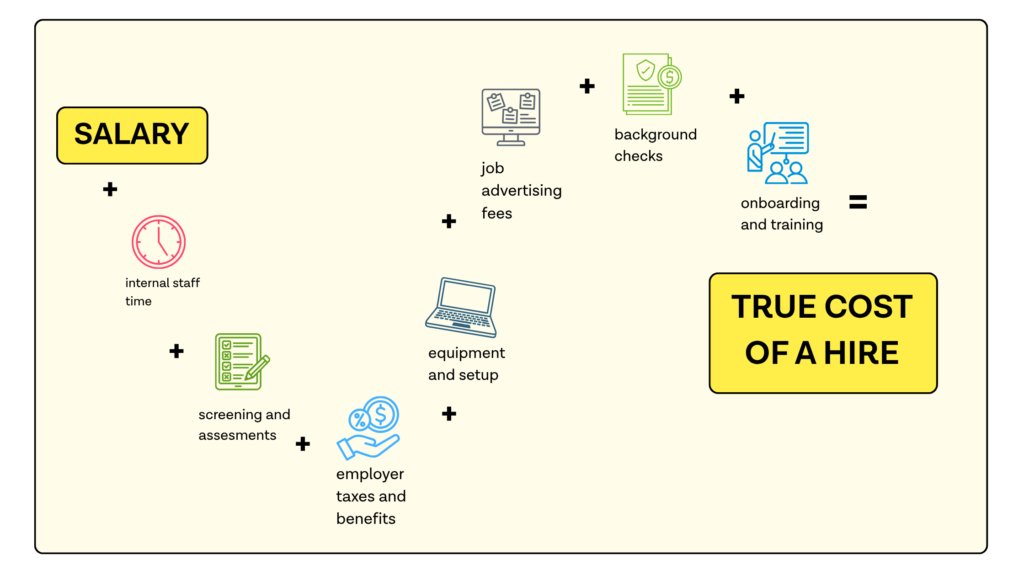
Seven categories cover the costs associated with hiring: internal staff time, advertising, screening, background checks, onboarding, employer taxes and benefits, and equipment. The SHRM and ANSI standard counts the first four as cost per hire; the last three are the cost of employing someone and are tracked separately.
1. Internal staff time. Your managers, HR lead and every interviewer are spending paid hours on recruiting, which makes them internal recruitment expenses. This is the biggest driver of a higher cost per hire, and most companies never put a dollar value on it.

2. Job advertising and posting fees. Indeed, LinkedIn, Glassdoor, niche job boards. These range from free to several thousand dollars per post, and many employers run several listings at once.
3. Screening and assessments. Phone screens, skills tests and structured interviews all take time. An applicant tracking system speeds up screening, and third-party assessments add another line to the invoice.
4. Background checks and drug screening. Standard for most professional roles and often required for any position involving finances, client access or safety. The per-candidate fee is small; the cost comes from running checks on candidates you should have ruled out earlier.
5. Onboarding and training. The first weeks are expensive. Training costs, manager time and the ramp-up period before the new hire is fully productive make onboarding costs the most underestimated bucket, and they count toward what it costs to employ someone rather than the standard cost-per-hire figure.
6. Employer taxes and benefits. For a new Idaho employer, Social Security and Medicare add 7.65 percent of wages, federal unemployment tax adds 0.6 percent on the first $7,000 after the state credit, and Idaho’s 2026 unemployment-insurance rate table sets the standard new-employer rate at 1.0 percent on the first $58,300 (IRS Topic 751, 2026) (IRS Topic 759, 2026). On a $65,000 salary that is about $5,600 in employer taxes, or 8.6 percent.
Idaho keeps that number low: the base unemployment-insurance rate for 2026 is 0.729 percent, the second lowest on record since 1980 (Governor of Idaho, 2025). Benefits are the bigger cost. BLS puts benefits at 30.0 percent of private-industry compensation, so wages plus taxes and benefits run about 1.43 times base pay (BLS, 2026).
7. Equipment and setup. Laptops, phones, software licenses, workspace and travel costs for final interviews. For remote or hybrid roles this category is easy to overlook until the invoices arrive.
Items 1 to 4 are what the ANSI standard means by CPH. Items 5 to 7 are the cost of employing the person, so factor in the cost when you budget, but keep them out of the CPH figure so your comparisons stay honest.
How much does it cost to hire a new employee in Boise, Idaho?
Workers in the Boise metro earned a mean $31.02 an hour in May 2025 against $33.54 nationally, so a Boise hire costs less in salary than the US average and the $5,475 SHRM recruiting average applies here as anywhere (BLS, 2026). The pressure is the pace: Ada County’s average weekly wage rose 7.9 percent in a year to $1,503, ranked 12th nationally (BLS, 2026).
That weekly wage is still about 9 percent under the national $1,654. Boise is not an expensive market to hire in, it is a tightening one, and the two things are easy to confuse when a search drags.
The tightness shows in the labor data: Ada County unemployment was 3.4 percent in June 2026 and the average covered wage reached $73,633 in 2025, up 4.4 percent (Idaho DOL, 2026). Idaho ranked third in the nation for wage growth, with the average wage up 4.7 percent to $29.41 (Governor of Idaho, 2026).
Boise employers also compete with remote-first companies paying national scales to Idaho-based workers. In our searches, the candidate who can say yes to an out-of-state salary from a Meridian address is the one who tests whether your offer was built on last year’s numbers, which is why we publish a Mountain West hiring and compensation report each year.
The table below puts the pieces together for the role families we place most. Salary is the BLS mean for Boise annualized at 2,080 hours, the employment cost column applies the BLS benefits share, and the recruitment costs column is the SHRM national average.
| Occupation group | Boise mean wage, annualized | Employer taxes and benefits on top (about 43 percent) | Recruiting costs per hire (SHRM average) |
|---|---|---|---|
| Office and administrative support | $49,400 | $21,200 | $5,475 |
| Sales and related | $54,400 | $23,300 | $5,475 |
| Business and financial operations | $85,600 | $36,700 | $5,475 |
| Computer and mathematical | $105,700 | $45,300 | $5,475 |
| Management | $122,600 | $52,600 | $5,475 to $35,879 |
| All occupations, Boise metro | $64,500 | $27,700 | $5,475 |
| All occupations, United States | $69,800 | $29,900 | $5,475 |
Sources: wages from BLS Occupational Employment and Wages, Boise City, May 2025, hourly means × 2,080 (BLS, 2026); taxes and benefits from BLS Employer Costs for Employee Compensation, June 2026, where benefits are 30.0 percent of compensation, so about 43 percent on top of wages (BLS, 2026); recruiting benchmark from SHRM 2025 Benchmarking Reports, with the executive figure applied to the management row (SHRM, 2025).
Company size moves the cost of recruitment more than location does: a firm making two hires a year carries the full weight of manager time on each one, while a firm making twenty spreads its tooling and HR cost across all of them.
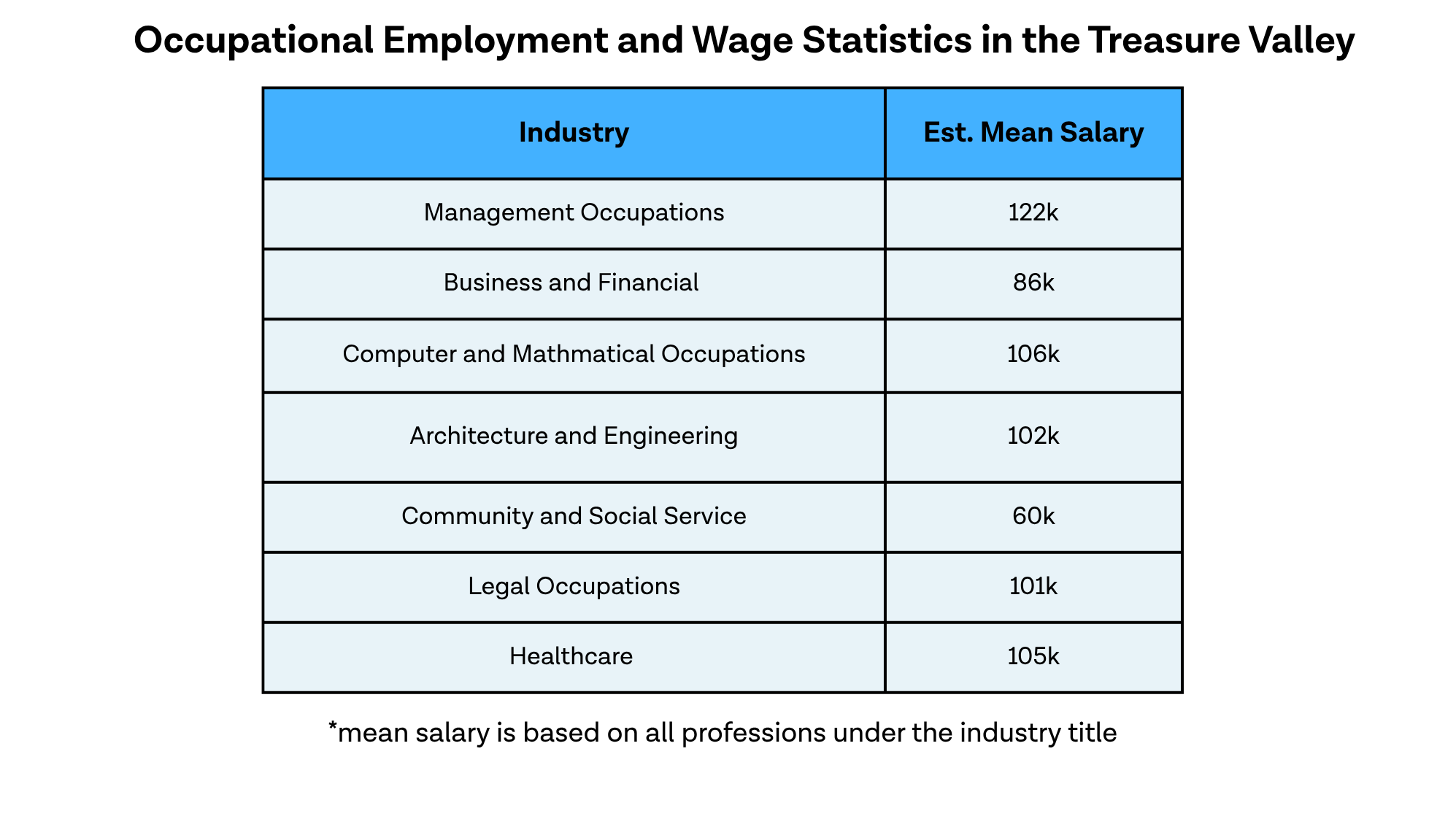
Treasure Valley mean annual salary by occupation group. Source: BLS Occupational Employment and Wages, Boise City, May 2025 (BLS, 2026).
How long does it take to hire someone in Boise?
SHRM’s 2025 report found the screening and interviewing phases each average 8 to 9 days, and once you add sourcing, an offer and a notice period, a well-run professional search runs into its second month (SHRM, 2025). In our Boise searches the calendar is set by two things: how fast the client can decide, and the notice period the candidate owes their current employer.
With Ada County unemployment at 3.4 percent, the people you want are already employed and usually talking to someone else (Idaho DOL, 2026). We advise clients to book interview slots before the search opens, because a week lost between rounds is where good candidates go quiet.
Specialized technical and leadership roles run longer, and every day the seat sits open has a cost of its own. That is why time to fill belongs on the same scorecard as this recruiting metric.
What does a bad hire cost?
A bad hire costs the salary you paid while it did not work out, the cost of running the search again, and the months a manager spent on a performance problem instead of leading the team. Only 20 percent of organizations track quality of hire, so most employers never see that number (SHRM, 2025).
Hire quality belongs right next to CPH on any HR scorecard, because the cheapest hire that fails is the most expensive one you make. We work through the full math, including morale and client relationships, in the true cost of a bad hire.
Is it cheaper to use a recruiter or hire on your own?
Running your recruitment efforts yourself keeps the fee off the invoice, but it puts sourcing, screening and selling the role on an internal team that already has a full-time job. A direct-hire recruiter charges a fee only when the candidate starts, and what the fee buys is reach to people who are not applying anywhere.
There is a real trade-off. For most small to mid-sized Boise businesses, doing it in-house means a hiring manager who is already at capacity taking on a second job, and internal recruiting costs that never show up on a spreadsheet.

A direct-hire fee is a percentage of the hire’s first-year salary, and it sounds significant until you weigh it against weeks of internal time, a longer search, and the risk of settling for the candidate who was available rather than the one who was right. Ask any recruiter to quote the fee up front and to say what happens if the hire leaves early; the answers tell you more than the percentage does.
We have placed more than 300 full-time, permanent professional and leadership roles across Idaho and the Mountain West since Jessica Cafferty founded RNG Group in Boise in 2015, and we do not do temp, contract or temp-to-hire work. If you want to talk through what a search would look like for your next role, we are here.
How do you reduce cost per hire without lowering quality?
The cheapest search is the one that is defined before it starts, moves quickly, and draws on people you already know. These five ways to reduce the cost per hire each cut screening time or days open, and none of them lowers the bar.
1. Define the role before you post it. A vague job description attracts a high volume of poor-fit applicants, which eats screening time. In our experience a written scorecard agreed by every interviewer before the posting goes live is the single change that saves the most hours.

2. Build an employee referral program. Referred candidates are faster to hire and cheaper to source than most recruitment methods, and they arrive with a realistic picture of the job. Even a modest referral bonus can reduce costs quickly.
3. Keep your pipeline warm. The most expensive searches start from zero. Staying in contact with strong candidates whose timing was wrong means your next hire has a head start and a shorter search.
4. Shorten your interview process. Every unnecessary round adds days to your time to hire and risks losing your top candidate to a faster-moving competitor. Audit your process and cut any round that does not add information; it is the fastest way to improve your hiring.
5. Measure it. Track the cost-per-hire metric, time to fill and hire quality together, since only one organization in five tracks hire quality and cost alone rewards the wrong behavior (SHRM, 2025). The calculator linked at the end of this article gives you a starting figure in a few minutes.
Frequently asked questions
What is a good cost per hire?
SHRM’s 2025 average amount is $5,475 for nonexecutive roles and $35,879 for executive roles, and because a few expensive executive and specialist searches pull the mean up, a typical professional hire lands below it (SHRM, 2025). A good cost per hire comes in under the benchmark for that seniority without stretching time to fill or lowering the bar.
Does cost per hire include salary?
No. CPH measures what you spend on the recruitment process to find and select the person, not what you pay them once they are working; salary, benefits and payroll taxes are part of your cost of employment and are tracked separately.
How much should a company budget for a hire?
To calculate the cost of a $65,000 Boise role, plan a recruitment budget of about $5,500, which is SHRM’s 2025 average, then about $93,000 in first-year wages, taxes and benefits, because BLS puts benefits at 30 percent of compensation (SHRM, 2025) (BLS, 2026). Of that, employer Social Security and Medicare plus federal and Idaho unemployment tax come to about $5,600 for a new employer (IRS Topic 751, 2026).
Is it cheaper to promote from within or hire externally?
Promoting from within is usually faster and cheaper when the right person is already on the team, and keeping a good employee is almost always cheaper than replacing one. External hires bring skills and perspective you do not have, at a higher upfront cost and a longer ramp, so decide deliberately rather than defaulting to one or the other.
What is an open role costing you right now?
Cost per hire is what you spend to fill a seat. Cost of vacancy is what the empty seat costs you every day it stays open, in lost output, overtime and delayed work, and it is usually the larger number.
You now have what you need for calculating the total cost of a hire. The next question is what it costs to wait.
Run your numbers in the cost per hire calculator
Filed under: Direct-Hire Placement