
Manufacturing recruiters: four reasons leadership roles are hard to staff in Idaho

When a plant manager or quality leader role sits open for months, the usual explanation is the labor market. Sometimes that is true.
Far more often the constraint sits inside the hiring process, where it is fixable. This guide is for plant owners and operations leaders at Idaho manufacturing companies who cannot fill plant, production, quality, supply chain and operations leadership roles, and who are wondering whether it is time to call manufacturing recruiters.
Why are manufacturing positions hard to fill?
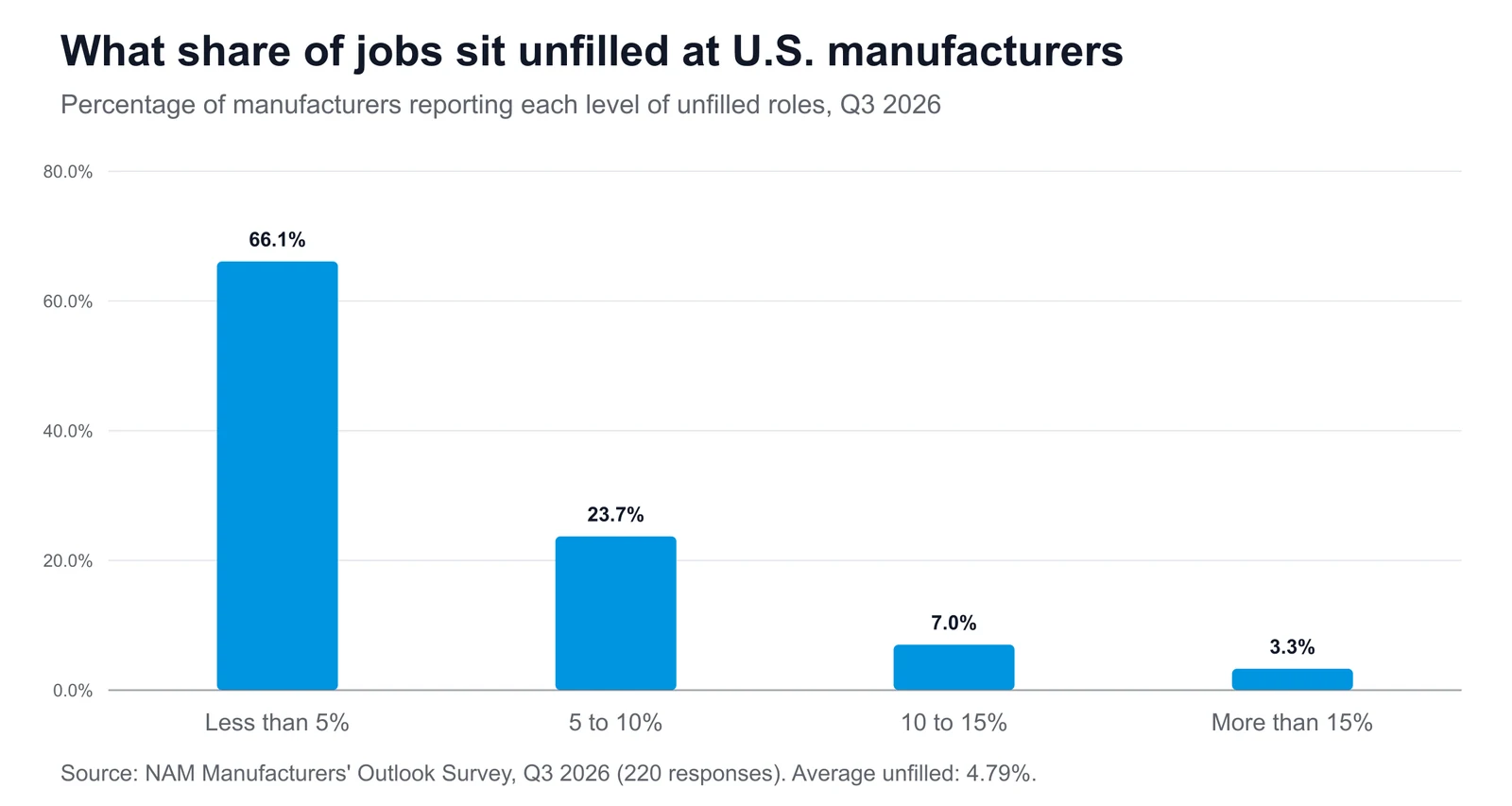
Part of it is real: the manufacturing industry needs millions of people over the next decade. But most plants have only a small share of open positions at any time, so a leadership role open for months usually points to the search, not the market.
The long-run math is hard. A Deloitte and Manufacturing Institute study found U.S. manufacturing could need up to 3.8 million workers between 2024 and 2033, and more than 1.9 million of those jobs could go unfilled (NAM, 2024).
The quarterly picture is calmer. In the Q3 2026 survey from the National Association of Manufacturers, 66 percent of manufacturers said fewer than 5 percent of their jobs remain unfilled, and the average was 4.79 percent (NAM Q3 2026).
Workforce is a real concern, but not the top one. Attracting and retaining a quality workforce was cited by 54.93 percent of respondents, fourth behind raw material costs, healthcare and insurance costs, and trade uncertainty (NAM Q3 2026).
So yes, the manufacturing sector has a skills gap. No, it is not why your specific plant leadership role has been open since spring.
How much manufacturing talent does Idaho have?
Idaho manufacturing employment has grown through 2026. That is a sizable base of plants competing for the same small group of experienced leaders.
Idaho had 77,500 manufacturing jobs in September 2026 (preliminary), up from 75,100 in March 2026, seasonally adjusted (BLS, 2026). Our guide to manufacturing in Idaho covers the sectors and regions behind that number.
Pay is part of the picture. Boise wages run about 7.5 percent below the national mean, $31.02 against $33.54 an hour (BLS OEWS, 2026), while Ada County wages are rising about twice as fast as the U.S., 7.9 percent against 3.9 percent (BLS QCEW, 2026).
That gap is closing fast, so a salary range set two years ago can already be behind the market.
Why do plant leadership roles take longer to fill than production jobs?
Leadership roles draw on a much smaller pool of people with years of plant experience, and most of them are employed rather than active job seekers. You cannot post your way to them; someone has to source them and make the case.
Industrial production managers typically need a bachelor’s degree and five years or more of experience, earn a median $126,060, and hold about 252,100 jobs nationally (BLS OOH, 2026). The Bureau of Labor Statistics projects only about 17,000 openings a year for the role across the whole country (BLS OOH, 2026).

The engineering bench is under more pressure, including the industrial engineers who lead manufacturing automation projects. Industrial engineer jobs are projected to grow 12 percent from 2025 to 2035, with about 23,100 openings a year (BLS OOH, 2026).
A production shortage and a leadership search are different problems with different fixes. RNG Group places plant, quality, supply chain and operations leaders, not production workers or trades, so everything below is about the leadership search.
Why does manufacturing recruiting for leadership roles stall?
In our searches, four things stall the recruitment process for most manufacturing leadership job openings: a requirement list nobody can meet, too many interview stages, the wrong salary benchmark, and no clear decision owner. All four sit inside your process.
Is the requirement list one nobody can meet?
Requirements accumulate. Each stakeholder adds one, nobody removes any, and the finished description describes a person who does not exist, or who exists and is paid considerably more than the range allows.
A useful exercise: separate the list into what someone must have on day one and what they could learn in ninety days. The second list is usually longer than anyone expects.
We see this with plant manager and quality manager searches, where a decade in the exact same process is demanded when a strong leader from an adjacent sector from related industries could be running the floor well inside a quarter.
Trim the must-haves and you widen the pool without lowering the bar, the same principle behind our manufacturing staffing strategies.
Does the interview and hiring process have too many stages?
Five rounds is not thoroughness, it is attrition. Every extra stage is another week for a competitor to move faster, and top candidates read a slow process as a sign of an indecisive organization.
Plant and operations leaders are usually employed while they interview. They are stepping away from a running operation to talk to you.
An operations director who takes a half day for a plant tour and then hears nothing for two weeks does not conclude that you are being careful. They conclude you are not serious, and you may lose them to the company that called back the same afternoon.
Our guide on how to reduce time to hire covers where those days go.
Was the salary benchmarked against the wrong market?
Plenty of manufacturing leadership roles are benchmarked against local averages that no longer reflect what the skill set commands. Certified quality and food safety leaders, maintenance and reliability managers, controls engineering leads and manufacturing engineering managers are all markets of their own.
If the range is wrong, no amount of sourcing fixes it. Have that conversation before the search starts, not after two declined offers.
Our Idaho salary benchmarking guide shows how to check a range against the skill rather than the zip code.
Experienced manufacturing recruiters will tell you a range is off early, because they are the ones who hear it from every candidate.
Does anyone own the hiring decision?
Searches stall when the hiring manager, plant leadership and HR staff each assume someone else is driving. Candidates feel it immediately.
Name one decision owner at the start, agree what evidence they need, and give them the authority to move. It costs nothing to fix.
Which manufacturing leadership roles are hardest to staff?
The hardest roles combine a small candidate pool with a high cost of getting a critical role wrong. Before you open any of them, check the few things that most often cause the search to stall.
| Role | Why it stays open | What to check before hiring |
|---|---|---|
| Plant manager | Few people have run a full site P&L, and most are settled in one | Which experience is truly day one, and who signs off the offer |
| Operations director or VP of operations | Multi-site leaders are rarely looking and move for scope, not title | Reporting line, authority over capital spend, and the relocation budget |
| Quality manager | Certifications and audit history narrow the pool quickly | Which standards the plant is audited against and which can be learned |
| Production manager | The role is often scoped as a supervisor job at a manager’s pay, or the reverse | Shift pattern, team size and headcount authority, written down |
| Manufacturing engineering manager | Engineers are in demand and many prefer technical work to managing people | Whether the job is leading engineers on design to production work or doing the engineering |
| Supply chain management leader | Candidates weigh the plant’s supplier mix and systems before they apply | Systems in use, the sourcing mix, and the targets they will own |
| Maintenance and reliability manager | Leaders who can move a plant from reactive to planned maintenance are scarce | Current downtime picture and the budget to change it |
When is it a genuine shortage in the manufacturing industry?
Sometimes the role really is hard to fill: a niche certification, a rural site, or a specialty with a handful of qualified leaders in the region. Finding the right talent for those searches takes a wider geographic net and a proper relocation case, not more job postings.

For those roles, the answer is a warm bench rather than a job ad. Plants that keep relationships warm with potential leaders between openings move faster, because the first conversation happened long before the vacancy existed.
The point is to know which situation you are in. A search that is failing for process reasons will not improve by waiting.
When should you call manufacturing recruiters?
Call a manufacturing recruiting firm when the role is senior, the right candidates are employed and not applying, or the search has already stalled once. A dedicated recruiter earns the fee by reaching people who are not looking and by telling you when the process is the problem.
The strongest plant and operations leaders, the top talent every plant wants, are rarely browsing job boards. Reaching them is outbound, specialized recruiting work, the part a good headhunter is paid for: identifying who runs comparable operations, making the case for your plant, and keeping them warm through a process that moves.
RNG Group is a Boise direct-hire recruiting firm, founded in 2015, that places full-time, permanent leadership and professional roles across Idaho and the Mountain West. For senior plant and operations roles with executive search requirements such as confidentiality, our executive search practice runs the search.
The fee is employer-paid, a percentage of first-year salary or a flat fee, and candidates never pay. See how our manufacturing recruiting works.
Frequently asked questions
Why do manufacturing roles stay open so long?
Usually one of four things: an impossible requirement list, too many interview stages, a salary benchmarked against the wrong market, or no clear decision owner. All four sit inside your process, and the talent gap is rarely the binding constraint on a single leadership role.
Is the manufacturing labor shortage getting worse?
The long-run gap is large, with more than 1.9 million manufacturing jobs that could go unfilled by 2033 (NAM, 2024). Workforce concern rose from 46.95 percent of manufacturers in Q2 2026 (NAM Q2 2026) to 54.93 percent in Q3 2026 (NAM Q3 2026).
Do manufacturing recruiters place production workers?
A staffing agency may, but RNG Group does not place production workers, tradespeople or temporary labor. We place direct-hire leaders and professionals, such as plant, quality, supply chain and operations managers.
What do manufacturing recruiters cost?
At RNG Group the employer pays, either a percentage of the hire’s first-year salary or a flat fee agreed up front. Candidates never pay a fee.
Is a plant leadership role stuck open?
We will tell you honestly whether the problem is the market or the process, and what it would take to fix it so you can hire with confidence. Tell us about your staffing needs and the role you are struggling to fill and book a call with our team.
Filed under: Recruiting