
Why Can’t I Find Qualified Candidates for My Open Role?


You probably have plenty of applicants. That’s the problem.
AI agents are applying to every role on people’s behalf, applications are tailored to mirror your job description, and the best applicants usually show up in the first week. So you end up screening a mountain of applications that all look right and you still can’t find qualified candidates for the role you need to fill.
I’m Jessica Cafferty, founder of RNG Group. We see employers struggling to find qualified talent with our own clients all the time, and people are talking about it constantly on Google and Reddit.
If you’re having trouble finding qualified candidates to fill a role, here’s what’s going on, and what to do about it.
Why am I getting so many applicants but none are right?
This is a real shift in the hiring process. Historically, the problem was that you weren’t seeing the people you were looking for, and you had to turn to other measures.
Today, in 2026, the hiring landscape has shifted: you get a flood of candidates for any role you post.
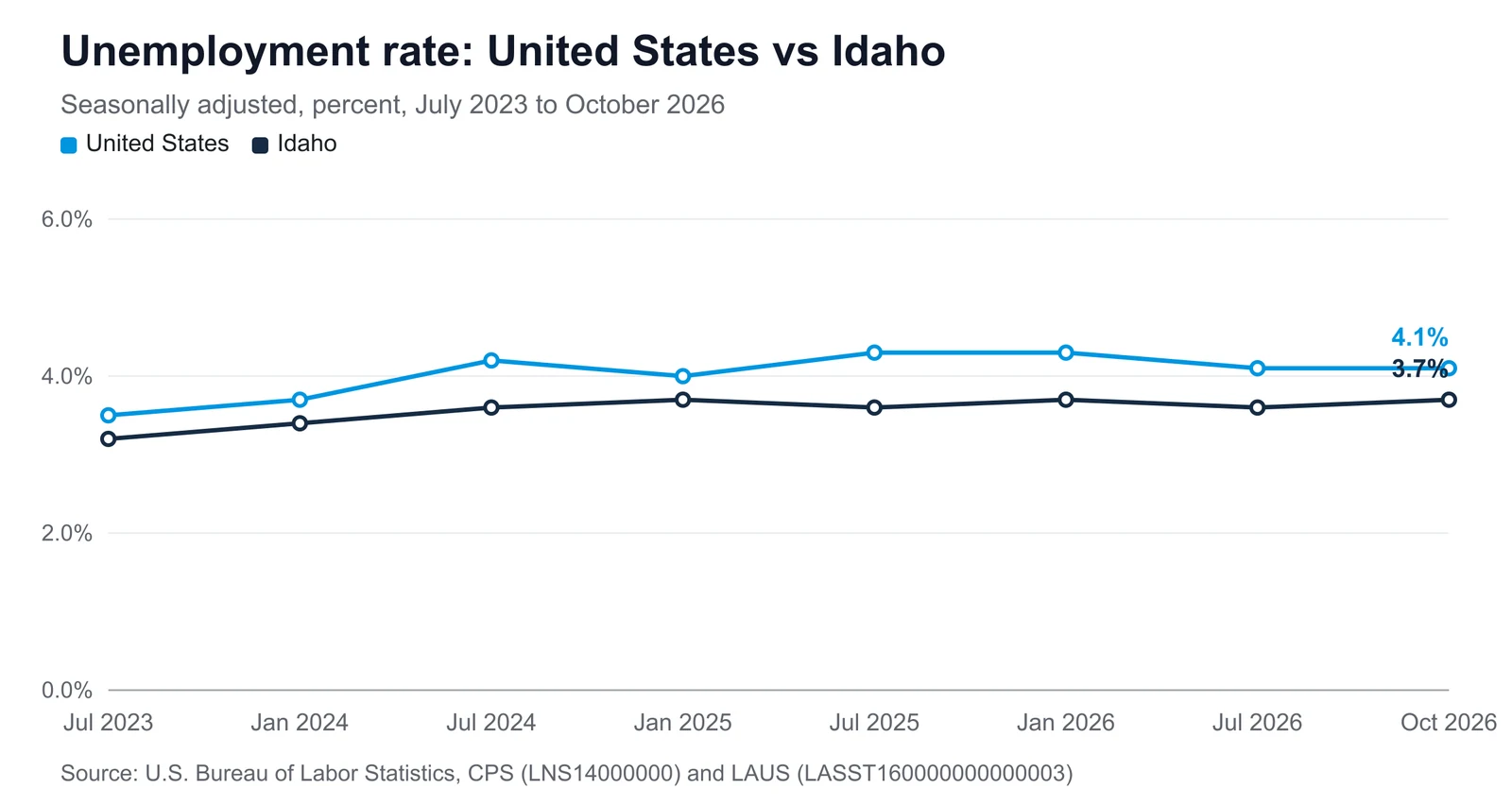
Part of that is simply more people looking for work in the job market, so the labor market feels very different for employers. Unemployment has gone up: the US rate rose from 3.5% in July 2023 to 4.1% in October 2026 (BLS, 2026).
In Idaho and the Mountain West it hasn’t been as significant as in other states, but it is happening. Idaho moved from 3.2% to 3.7% over the same stretch (BLS LAUS, 2026).
The bigger part is agents. A lot of smart job seekers are building AI agents to apply to roles on their behalf.
Any role that fits the filter they’ve set, the agent applies. And some people build one agent, then build another.
“Some of the time, one candidate will be represented by three different agents that are applying on their behalf.”
Jessica Cafferty, RNG Group
So if you’re getting three applications for one candidate, that’s definitely inundating your inbox. It’s not always true, but it’s part of the problem.
Why do the resumes all look like a perfect fit?
Because they were built to. Everybody is using AI to build and tailor their resume, and the agent does it for them.
It takes your job description and their past work history and makes the two match, so even unqualified people can look like the perfect candidate.

“The resume is telling you what you want to see. It’s telling you what you want to hear.”
Jessica Cafferty, RNG Group
That means you have to dig underneath it. You have to meet with candidates to truly evaluate a candidate’s qualifications: do you have the skill set I’m asking for? Tell me about the results you’ve driven at the companies you’ve worked for.
That’s what can make hiring so exhausting when it’s not your only job. It happens across job titles: say you’re a CTO who needs a software engineer, a COO hiring a director of operations, or a CFO hiring an accountant.
You’re not HR staff and you’re not in talent acquisition, and now you have to invest all that time and energy evaluating candidates who may look highly qualified on paper. And through all of that, many employers are still not finding the best candidate, because the specifics matter and that nuance isn’t coming through on paper.
Should I keep the job post up longer?
I don’t think keeping a job opening up longer solves the problem.
In my experience, your best candidates usually come within the first week of posting a job. Nothing is binary, but that’s the way the cookie crumbles. After about two weeks, the same profiles just circulate and you don’t get the fresh new talent you’d hope for.
And it costs you. LinkedIn is making a killing on job ads right now.
If you post a job on LinkedIn today as a hiring manager or a founder, plan on spending a couple thousand dollars to stand out. Indeed is sort of the same, and that cost adds up across job openings.
Keeping the post open on those job boards means you keep paying for that budget.
Here’s how I think about the life of a job post:
| Time since posting | What usually happens | What to do |
|---|---|---|
| First week | Your best candidates usually apply | Screen and meet the strongest ones |
| About two weeks | The same profiles circulate, little fresh talent | Stop waiting for the post to fix it |
| About 30 days | The point the post should come down | Take it down and rethink the search |
| 60+ days | You’re stuck and still paying for job ads | Do your own outreach, flex the levers or bring in a partner |
Is it my job description or the pay?
It depends on the role and on the feedback you’re getting from candidates. But my argument is that in today’s market, because you’re getting so many candidates, the job description is not the deciding factor between a good candidate finding you and being the exact right fit.
That said, when a role is stuck, it’s a worthy exercise to re-examine the job description. Making it more fun or more reflective of your company culture can’t hurt. The more useful question is: what levers can you change?

- Requirements. If the experience you want doesn’t exist out there, can you be more flexible and still find good candidates?
- Industry background. Can you hire someone with slightly different industry experience who is capable of learning, and train them?
- Location. Do you need a national search, pulling people from other states because you can’t find enough local candidates?
If it’s location, market the posting in those places. Here in Boise, that might mean posting the job in Seattle, Denver or Salt Lake.
Budget for it: posting in larger cities generally costs more. And a bigger city means a bigger talent pool, more agents applying and more profiles to screen.
That may be fine if you end up finding the person you need.
My role has been open 60+ days. What do I do now?
If you don’t have the budget for a recruiting partner, the first thing I recommend is taking the posting down. Honestly, you probably should have taken it down about 30 days ago. If you just repost it, you’ll have the same problem: candidates who feel like the right fit because their applications were tailored to your job description, but aren’t.
Then:
- Do your own outreach. Put on your own headhunting hat and go find the right person, including passive candidates who are already employed and not actively looking for a new role, on LinkedIn or Indeed.
- Get in the right rooms. Put yourself where the people you want to hire are.
- Build a bench. If you have open positions that are consistently open, start building candidate networks before you need to fill positions.
“It doesn’t mean you need to hire today. It means you need to have them on your radar for the future.”
Jessica Cafferty, RNG Group
One of our clients is in civil engineering. They may not need an entry-level EIT today, but they should be meeting EITs consistently, because those are the PEs of tomorrow. You need those relationships to hire them in two or three years. I know that doesn’t solve your problem today, but it’s the bigger-picture way to think about workforce planning.
When does a recruiting partner make sense?
I’d be remiss not to say it: a good partner can solve these problems faster. With a search partner like RNG, you hand us the job description, the nuance of your culture and the kind of person you want. We run the recruitment process, find that person, screen the candidates and deliver qualified candidates you can move forward with.
If you want to see how that works, here’s how to work with a recruiter.

Yes, there’s an additional cost, and yes, it’s more than posting on LinkedIn or Indeed. But what’s your time worth?
If you’re a founder with 100 million things on your plate, or a COO, CFO or director of sales, your job is closing business and keeping the company afloat. A partner can save you the 60 days, 90 days or six months of waiting to see if the right person finds your posting, plus the screening and all those conversations.
You can put a number on that with our cost-per-hire calculator, and for senior roles, here’s what executive search involves.
Frequently asked questions
Why are there so many applicants for every job posting?
More people are looking for a job, and many now use AI agents that apply to every role matching their filters. One candidate can be behind several applications.
How long should I keep a job posting open?
In my experience, your best applicants usually arrive in the first week, and after about two weeks the same profiles circulate. Past that point, more time mostly means more cost.
What should I do if a role has been open for more than 60 days?
Take the posting down instead of reposting it, re-examine which requirements you can flex, do your own outreach, and consider a recruiting partner.
Is a recruiter worth the cost compared to job boards?
It costs more than a posting, but it saves the time you’d spend screening resumes and waiting months for the right person. For a busy founder or executive making hiring decisions, that time is usually worth more.
Filed under: Recruiting · Recruiting Process